
A clinical trial is one of the final stages of a long and complex research process to identify new treatments and interventions.
It is a study involving human beings, carefully designed to answer a scientific question and determine whether a promising approach to prevention, diagnostic technique or treatment is safe and/or effective.
NBCC works with research organizations to improve trial design and monitoring, increase access and accrual, educate the medical community and consumers, and initiate high-quality breast cancer trials.
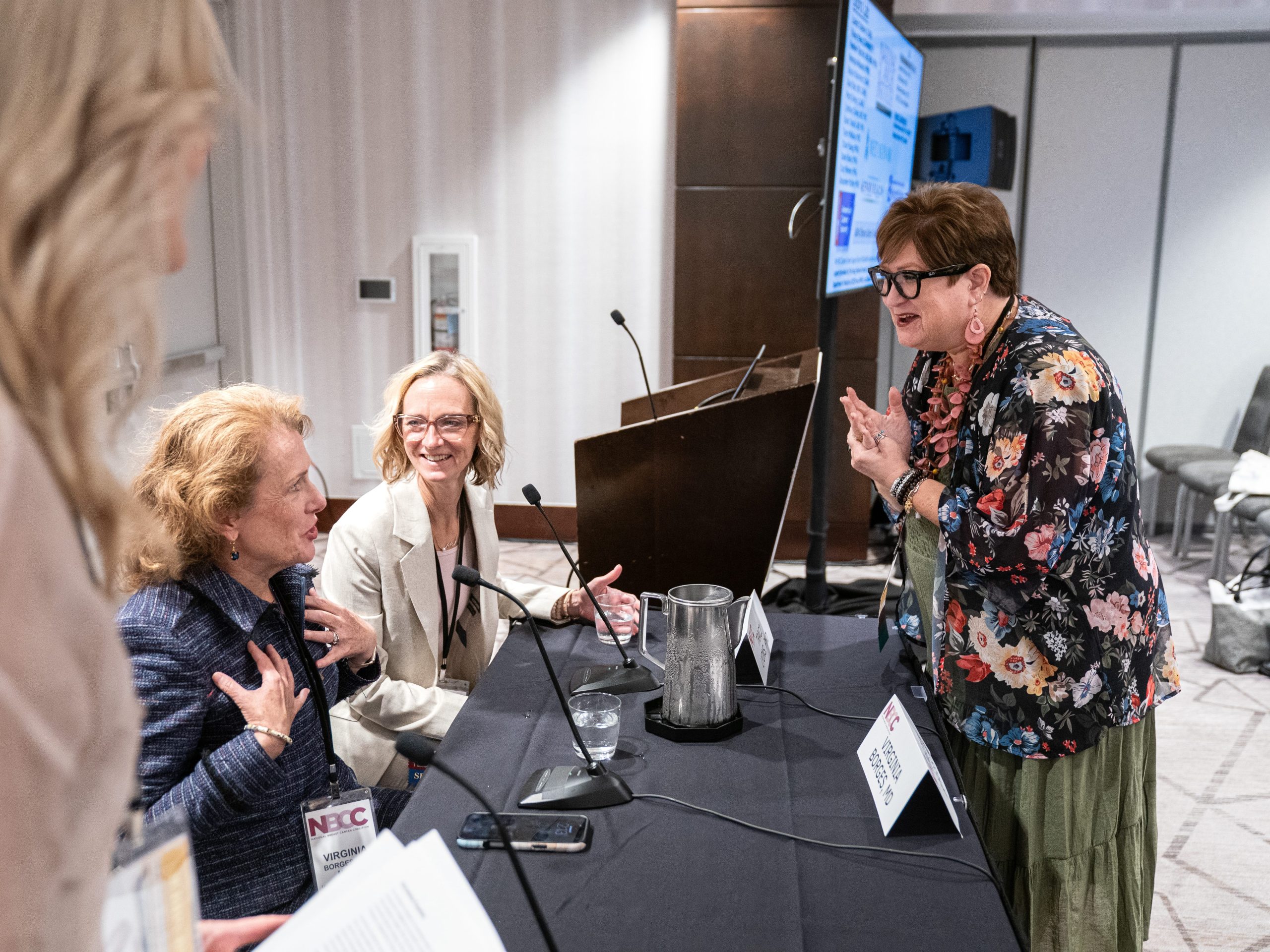
Trained advocates participate in early development of trial protocols as members of the steering committees and data safety monitoring boards, as reviewers of educational materials and consent forms, and in conducting outreach to educate the public about specific trials.

Related Resources
- Beyond Measuring Quality of Life in Cancer Trials: Making Results Meaningful for Patients
- Rethinking DCIS: What the COMET Trial Means for Patients
- Do Patients Gain More Than They Risk in Cancer Trials?
- Uninformative Clinical Trials: Why They Happen and How Advocates Can Drive Change
- Finding Clinical Trials that Meet the Needs of Breast Cancer Patients & their Families
Active Trials
NATALEE clinical trial for the CDK4/6 inhibitor Ribociclib [LEE-011]
Purpose: To evaluate the efficacy and safety of ribociclib, a CDK4/6 inhibitor, in combination with endocrine therapy for patients with hormone receptor-positive, HER2-negative (HR+/HER2−) early breast cancer.
NATALEE is a phase 3, randomized clinical trial conducted in collaboration with Translational Research in Oncology (TRIO) and Novartis Pharmaceuticals. The trial evaluates ribociclib in combination with endocrine therapy compared with endocrine therapy alone as adjuvant treatment for patients with HR+/HER2− early breast cancer.
NBCC participated in the trial through advocate representation on the Steering Committee, Data Safety Monitoring Board, and Translational Research Committee. NBCC advocates also reviewed the study protocol and informed consent materials, providing input from the patient perspective. In addition, NBCC contributed to early efforts to help clinical trial sites improve participant recruitment and minimize study attrition.
Enrollment has been completed, and multiple analyses of trial results have been published. Long-term follow-up continues to assess outcomes.
For additional information about the trial, including its design, status, and available results, visit ClinicalTrials.gov.
Trial Partnerships
NBCC selectively collaborates with researchers, academic institutions, and industry partners on clinical trials that address important questions and have the potential to meaningfully improve outcomes for people with breast cancer. Our collaborations are guided by a commitment to scientific rigor, ethical research, patient-centered outcomes, and meaningful advocate involvement throughout the research process.
Organizations interested in collaborating with NBCC are encouraged to review our criteria and expectations for clinical trial partnerships outlined below.
For inquiries about potential collaborations:
NBCC Clinical Trial Collaboration Criteria and Expectations
Criteria for Clinical Trial Collaboration
- The study must be designed to answer an important, novel question relevant to breast cancer.
- The study must be well-designed, scientifically rigorous, and employ appropriate and meaningful outcomes.
- The study must be conducted in an ethical manner, with sufficient data supporting efficacy and safety. Participants must have sufficient information to provide meaningful informed consent, and the study must be approved by an institutional review board (IRB). The trial must employ mechanisms for adequate participant privacy protection and confidentiality of participant information. A data and safety monitoring committee or similar system must be in place for evaluating the protocol and patient safety as the trial proceeds.
- Research agreements between the trial sponsor and any academic/independent investigators must adhere to all guidelines for sponsorship, authorship, and accountability outlined by the International Committee of Medical Journal Editors’ Uniform Requirements for Manuscripts Submitted to Biomedical Journals. Academic or independent research institutions participating in the study must be involved in trial design, recruitment, and data interpretation.
- A mechanism must be in place to adequately address NBCC’s concerns about payment of costs for participants’ care.
- The trial must adequately address NBCC’s concerns about the inclusion of a diverse population and inappropriate exclusion of specific populations.
- The trial must meet NBCC’s expectations, which are listed below.
NBCC’s Role and Responsibilities
- NBCC will provide formal and informal input from knowledgeable patient advocates on study design and implementation.
- NBCC will assist in designing outreach materials to educate the public and potential trial participants.
- NBCC will assist with recruitment via its website and other outreach methods and through its extensive grassroots network. NBCC will develop a strategy specific to the trial to help with accrual and outreach.
- NBCC will assist in designing an expanded access program if necessary.
- NBCC will disseminate trial information as quickly as possible.
- NBCC will attend meetings with regulators as appropriate.
Expectations of Research Partners
- The sponsor will afford NBCC opportunities for meaningful input into study design and implementation.
- NBCC representatives will sit on study committees, data and safety monitoring committees, and other advisory committees and panels.
- NBCC representatives will attend investigator meetings.
- The sponsor will provide NBCC with opportunities for meaningful review of and input regarding safety data.
- The trial sponsors will provide NBCC with information about every breast cancer clinical trial they are conducting.
- To the extent feasible the sponsor will provide trial participants and breast cancer advocates with updates on the trial’s progress, status, and results, even if the trial is cancelled or ends early.
- The primary results of the study will be published in full form in a respected peer-reviewed journal. The findings will be disseminated regardless of final FDA approval, the strength or direction of the results, or findings of significant adverse events.